Category Archives: Consumption

Dumpsters, Muffins, Waste and Law

A guest post by Sebastian Abrahamsson and Katja de Vries. This is the fourth post in a series of guest posts by participants of the Association of American Geographers conference series on waste. Dumpsters, Muffins, Waste and Law Sebastian Abrahamsson and Katja de Vries I. This is a bag of muffins. Muffins are edible breads that […]
Read More »
“Singapore is a gold mine”: Re-Orienting global trade flows of secondhand electronics. Guest post by Creighton Connolly.

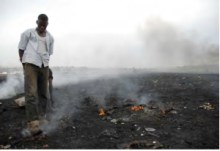
Trade within developing regions is increasing in prevalence due to the falling price of electronics and increasing affluence in those countries. This finding thus makes the Basel Convention largely irrelevant, as it only bans trade from developed to developing regions. Yet, it is clear that Singapore generates at least as much, if not more electronic waste per capita than European and North American countries. Therefore, national e-waste legislation, as well as international policy aiming to reduce the international flow of secondhand electronics, such as the Basel Convention as well, needs to take seriously the role that countries like Singapore play as significant sources of such devices.

Wasted opportunities? Waste-to-Energy in the United States. Guest post by Jordan Howell

Since the American Association of Geographers (AAG) held a unprecedented number of sessions on waste in February of this year, the Discard Studies blog has invited participants from the AAG to post their work. This post is by Jordan Howell, a PhD student in the Department of Geography at Michigan State University. One of the […]
Read More »

Visual Culture of Food Waste Data: Theaters of Proof

By Max Liboiron A lot of discard issues are about scale. Scale is expressed in functions of measurement or computation, yet scale is more than a quantitative sum. Scale is always relative (“bigger,” “smaller,” “less than,” “twice as much,” “a quarter of”), and therefore relational. So scale is not merely about being big or small. […]
Read More »

Seduction of the instantaneous

By Robin Nagle. There’s something to be said for deep engagement.  I agree with Wolfgang Iser, the literary theorist and co-founder of the sub-discipline of literary anthropology, who argued passionately that focused engagement with a text can truly transform the reader (see The Act of Reading).  Although Iser was mostly concerned with works of literature, his theory […]
Read More »

The Art of Mould

By Max Liboiron I love mould. It is invisible, yet suddenly visible if you let it take over parts of your fridge or bathroom; it can come back from the dead; it is neither animal nor plant. It is mysterious and beautiful. To that end, here are some artists who use mould as a medium […]
Read More »

Under the radar, off the books

By Robin Nagle “What is the aboriginal Self, on which a universal reliance may be grounded?”  Emerson, “Self Reliance” Nannies, drug dealers, pimps and prostitutes, freelance carpenters, water entrepreneurs, “gypsy-cab” drivers, babysitters, street vendors and sidewalk gamesmen — what they all share in common is a life spent precariously under the radar (Venkatesh 2006), or […]
Read More »

Terribly charasmatic piles of tires

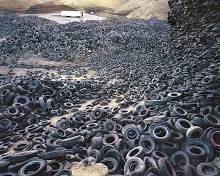
By Max Liboiron. One of the most popular search phrases that leads people to the Discard Studies blog is “pile of tires.” Perhaps the terrible charisma of piles of tires is why people search for the term on Google with such regularity? Is it the smell, the orderly stacking as the tidier version of hoarding, […]
Read More »

Capitalism and Socio-Spatial Dialectics of ‘Waste’

Antipode, A Radical Journal of Geography, has just published a special three-article section on the Socio-spatial dialectics of “waste.” The articles follow a Marxist analytical framework and are nestled in a larger discussion of humans and/as “surplus.” Readers will find that authors are not experts of waste and its materialities, stocks and flows, but are […]
Read More »

“Going Green but Getting Nowhere” — from the New York Times

Gernot Wagner, an economist with the Environmental Defense Fund, argues in this New York Times Op-Ed that our individual efforts to recycle, use less water, or replace plastic bags with cloth sacks are merely token gestures. “The changes necessary are so large and profound that they are beyond the reach of individual action,” he writes. […]
Read More »