Category Archives: Urban

Race, Class, and Disaster Gentrification

By Zoltán Glück Originally published in Tidal on March 13, 2013 In the days and weeks following Hurricane Sandy the inequalities at the heart of New York City could scarcely be missed.  While hundreds of thousands of public housing residents went without heat, hot water or electricity, Mayor Michael Bloomberg rushed to get the stock […]
Read More »
The space/time of modern waste: disaster trash

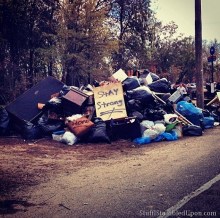
By Max Liboiron. As Samantha MacBride notes, modern waste–that is, postindustrial waste and particularly waste developed after 1945 when consumerism came into full swing in the United States– is synthetic, unpredictable, and heterogenous. Additionally, it has unique spatial and temporal characteristics compared to its predecessors. First, longevity: I’ve written elsewhere about the staggering longevity of plastics; […]
Read More »

Dumpster Diving

Reblogged from our friends at the fantastic Material World Blog. Aliine Lotman (Anthro Dept, EHI, Tallinn University) “Until the 19th century, the term ‘to consume’ was used mainly in its negative connotations of  ‘destruction’ and ‘waste’.  Tuberculosis was known as ‘consumption’, that is, a wasting disease.  Then  economists came up with a bizarre theory, which […]
Read More »

The unspeakable matter

While we often post article alerts about new scholarship on garbage matters, I wanted to take a moment to re-visit Ellen Handy’s 1995 essay, “Dust Piles and Damp Pavements: Excrement, Repression, and the Victorian City in Photography and Literature.”  First of all, thank you Ellen Handy for introducing readers to Thomas Annan’s enduring work (see “Dust […]
Read More »

Waste and Capitalism

Last night’s presentation of Surveying Waste and Capital at Trade School (NYC), lead by CUNY doctoral candidate Jesse Goldstein included a historical narrative starting in England during the enclosure movement and how the “wasteland,” originally referring to productive pasture and foraging land on the outskirts of a village’s agricultural fields, was reframed as “wasted spaces” […]
Read More »

Tactics of Waste, Dirt and Discard in the Occupy Movement: A Photo Essay

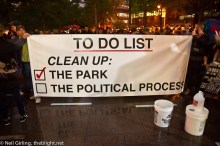
By Max Liboiron It has been one week since the one year anniversary of Occupy Wall Street, September 17, 2012. In celebration, let’s look at the movement through the lens of discard studies. My article, “Tactics of Waste, Dirt and Discard in the Occupy Movement“, has just appeared in Social Movement Studies: Journal of Social, […]
Read More »

Article Alert-Tactics of Waste, Dirt and Discard in the Occupy Movement

Currently “Tactics of Waste, Dirt and Discard in the Occupy Movement” is published as a forthcoming article in Social Movement Studies: Journal of Social, Cultural and Political Protest, but will soon be part of a special issue on the Occupy movement. From August until September, the special issue will have free and open access. When […]
Read More »

A Companion for Sewer Catastrophes

By Max Liboiron Sewers are the most expensive and expansive urban infrastructures in North America. They are underground. They are made of inflexible pipes.They are difficult to access. And increasingly unpredictable acts of nature, from earthquakes to climate disruption, are making the probability of their spectacular, large-scale failure something to take note of. A couple […]
Read More »

OWS vs. City of New York: Leveraging Discard Politics

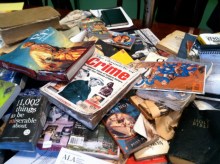
By Max Liboiron Occupy Wall Street, and specifically representatives of the People’s Library, are suing New York City’s Mayor Bloomberg, its police commissioner Ray Kelly, the Sanitation Commissioner John Doherty, and other City officials in the seizure and discard of 2,798 books during the raid on Zuccotti Park on November 15, 2011. If you are […]
Read More »

Speaking out of place: First Amendment Rights Area

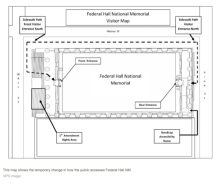
By Max Liboiron. When visiting National Parks, be sure to note the location of the nearest “1st Amendment Rights Area.” As a reminder, this is the First Amendment: “Congress shall make no law respecting an establishment of religion, or prohibiting the free exercise thereof; or abridging the freedom of speech, or of the press; or […]
Read More »