Category Archives: Environment

Trump may reverse US climate policy but will have trouble dismantling EPA

History suggests that it may be harder to make radical cuts at EPA than Trump and his advisors think. While many politicians have called for eliminating entire cabinet agencies, none has succeeded.
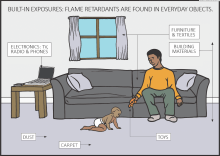
How toxic flame retardant chemicals become-and stay-ubiquitous in our homes and bodies

A new report highlights the failure of Canadian federal regulations to keep harmful flame retardant chemicals out of homes and consumer products. In fact, it argues that current regulations keep toxic chemicals *in* homes and bodies.

On Solidarity and Molecules (#MakeMuskratRight)

Deferring to molecules rather than social movements when it comes to contamination is a case of power relations.

Location, location, location: why South Australia could take the world’s nuclear waste

South Australia’s Nuclear Fuel Cycle Royal Commission has recommended the state investigate an international storage site for intermediate and high-level (spent fuel) nuclear waste.

Modern Waste and Industrial Ruins in the Anthropocene

Regarding Giant Mine, the Canadian government’s plan for containment involves freezing the arsenic underground in perpetuity. Beyond the technical challenges, the question of how to communicate risk and containment to future generations by imagining a time in the distant future unlike anything we know now is no easy task.

Environmentality

Governmentality and environmentality can articulate how and why waste becomes a medium through which to understand power and changing human-waste interactions

Anthropocene Adjustments: Discarding the Technosphere

The technosphere refers to a new layer on the planet made up of “the interlinked set of communication, transportation, bureaucratic and other systems that act to metabolize fossil fuels and other energy resources.” We write this post to share some lingering thoughts on this theme, including what we think critical discard studies (CDS) might contribute to the technosphere discussion.

A Bibliography for Teaching Flint

This bibliography is designed for professors who want to “teach Flint” in their classrooms. The Flint, Michigan water crisis is an extreme but quintessential case study that shows the intersections of environmental health, governance, the built environment, systemic racism, and social inequity.

Thompson on Sills, ‘Toxic War: The Story of Agent Orange’

The use of the defoliant Agent Orange by the United States is one of the most controversial actions of the Vietnam War. InToxic War: The Story of Agent Orange, Peter Sills provides much-needed clarity to the history of Agent Orange with his use of data made available by legal proceedings.

Environmental historians get wasted: ASEH conference report

What’s my take on this torrent of waste at ASEH? I think it really signals a maturation of a second generation of waste scholarship in environmental history that began in the early 2000s.