Category Archives: Waste

Against Awareness, For Scale: Garbage is Infrastructure, Not Behavior

The journey from awareness to behavior change is a long and arduous one, and few make it. Even for those who change their behavior, the scale of the change is often too small to impact the problem at hand. So what do we do?

Special issue of Bulletin of the Atomic Scientists: Destruction, Art, and the Doomsday Clock

In this special issue of the Bulletin of the Atomic Scientists, authors reflect on how, when and why art has been used to articulate destruction over the past decades. Their essays are a glimpse into the topics that were recently discussed at the 2013 Doomsday Clock Symposium in Washington, DC.

The visual culture of post-disaster high water marks

f you look at enough photographs of disasters, you will see people posing with high water marks. It is a genre of photography onto itself: over and over, they will point to the mark, put their bodies in front of the mark, or photograph the high water line alone. This post explores the possible roles that the visual culture of post-disaster high water marks play, especially given the prevalence of the genre across disasters, geography, and time.

Sanitation Workers: Hurricane Sandy’s First Responders

“We were the first ones there. And not only were we the first; we were the best. You know? We were the first responders in areas that nobody knew about– like I went to Sheepshead Bay and Arlene Avenue. It’s strange because if you’re driving up and down it, you wouldn’t notice them. But there were maybe a couple of dozen small houses. Nobody else knew they were down there. Our sanitation guys knew where every little nook and cranny was.”

Trash, debris, or neither? The Nature of Waste During Disaster

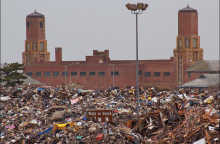
Not only do natural (and unnatural) disasters produce a lot of waste, they are also extreme but oddly quintessential events where practices, behavior, and cultures around waste and wasting, as well as their inverse–repairing, fixing, rebuilding–move to the fore. In the weeks proceeding and following the one year anniversary of Hurricane Sandy making landfall in New York City and surrounding area, Discard Studies will feature a series of articles about the complexities of disaster and waste, broadly defined. This article looks at the material and emotional nature of waste during disaster.

Bibliography on Noise Pollution

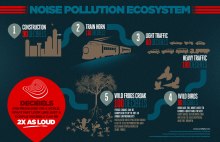
If waste is, broadly defined, the externalities of social and technical systems, then noise is a quintessential form of waste. Noise pollution is disturbing or excessive sound that may harm humans or animals, and, not surprisingly, it usually emits from industrial technologies. Perhaps because it exceeds the material fetish of most pollution laws, it wasn’t until the 1970s (1975 in Portland, to be exact) that U.S. governments promoted noise from a “nuisance” to f a full fledged environmental problem like its material cousins in the pollution panoply. Yet, noise remains a generally neglected source for the theorization of waste, pollution, and harm. If you are interested in remedying the situation, here is a bibliography for you:

Tales from Our Trash: Sanitation Workers, Sustainable Cities, and the Value of Knowledge

Held in honor of Frank Justich, a NYC Sanitation worker killed on the job in Astoria in 2010, the event will feature a discussion with Professor Robin Nagle (author of Picking Up, and the anthropologist-in-residence with the NYC Department of Sanitation), as well as presentations by the NYC Commissioner of Sanitation, John Dougherty, and conceptual artist, Mierle Laderman Ulekes (artist-in-residence with the NYC Department of Sanitation), and youth activists representing future generations. The event is the first in CUER’s planned series focusing on trash as a lens for considering issues of sustainability. The focus of the evening’s conversation will be on trash as an issue of inter-generational equity, and the need to recognize sanitation workers as the front line of urban sustainability.

Discard Studies as Science and Technology Studies (STS)

Anthropologist Mary Douglas famously states that “dirt is ‘matter out of place,'” a deeply social reaction to materials “likely to confuse or contradict cherished classifications.” In our society, we use science to determine classifications and boundaries that put materials in and out of place. That is: science is the privileged method for determining waste and pollution from non-waste and non-pollution.

Object Lessons

Object Lessons is an essay and book series about the unseen secret lives of ordinary things, from remote controls to morel mushrooms, blankets to barcodes. And, presumably, trash or things destined to become trash. Each Object Lessons project starts from a specific prompt: an anthropological query, archeological discovery, historical event, literary passage, personal narrative, philosophical […]
Read More »

A history of New York City’s solid waste management in photographs

By the nineteenth century, New York City was persistently and famously filthy. While other urban centers had begun to clean up their streets, approaching vessels could still smell New York far out to sea. Yet,  the Department of Sanitation (DSNY) was founded in 1881 as the Department of Street Cleaning and became one of the […]
Read More »