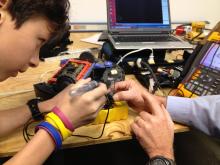
Open it up and look inside
A Black and Decker toaster oven, a pre-amplifier (and its sister amplifier), an electric hot water boiler for tea, and a monitor from an older computer — these are just some of the electronics and small appliances that have moved from inside of my home to the staging area known as the garage, to the […]
Read More »
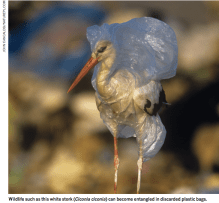
Scientists Call to Classify Plastic Waste as Hazardous Waste
By Max Liboiron. An international group of scientists, including the young Chelsea Rochman and Mark Anthony Browne from California, with the support of the veteran marine scientist Richard Thompson from the UK and a host of others from the USA and Japan, has called on policy-makers to classify plastic waste as hazardous waste. Their argument, published in the latest issue of […]
Read More »
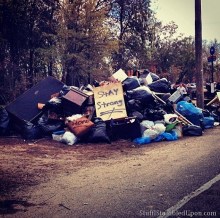
The space/time of modern waste: disaster trash
By Max Liboiron. As Samantha MacBride notes, modern waste–that is, postindustrial waste and particularly waste developed after 1945 when consumerism came into full swing in the United States– is synthetic, unpredictable, and heterogenous. Additionally, it has unique spatial and temporal characteristics compared to its predecessors. First, longevity: I’ve written elsewhere about the staggering longevity of plastics; […]
Read More »

Global Food Report: 30–50% global food produced is discarded
By Max Liboiron. The Institution of Mechanical Engineers released their report on Global Food trends in anticipation of massive human population growth in the next 50 years. The trend that mattered most was the acute waste of nearly half the global food supply: Today, we produce about four billion metric tonnes of food per annum. […]
Read More »

Dumpster Diving
Reblogged from our friends at the fantastic Material World Blog. Aliine Lotman (Anthro Dept, EHI, Tallinn University) “Until the 19th century, the term ‘to consume’ was used mainly in its negative connotations of ‘destruction’ and ‘waste’. Tuberculosis was known as ‘consumption’, that is, a wasting disease. Then economists came up with a bizarre theory, which […]
Read More »

CFP: Excretion: Cognition, Perception and Behaviour in Rapidly Transitioning Cities of the Global South
Royal Geographical Society/ Institute of British Geographers Annual International Conference 2013 London August 28-30, 2013 Organiser: Deljana Iossifova, University of Manchester This session aims to bring together research related to one of the most perturbing issues for growing and developing cities of the Global South and their existing and future residents: attitudes toward excretion. Excretion-related […]
Read More »

One million years of isolation: an interview with Abraham Van Luik
Edited by Elizabeth Ellsworth and Jamie Kruse, Making the Geologic Now, has many entries on waste. Perhaps this is not surprising, since many of what Samantha MacBride calls “modern wastes,” characterized by their synthetic nature, unpredictability, and heterogeneity, are also permanent. From plastics to e-waste, industrially-generated waste now lasts in geological time rather than evolutionary […]
Read More »

New syllabi: “Wastelands”
Many thanks to Caitlin DeSilvey at the University of Exeter in the UK for submitting her syllabus “Wastelands.” Wastelands is an upper level course taught via the geography department. The course, or module, description is as follows: “In this module, waste-making is approached as a dynamic cultural phenomenon that works to stabilize (and destabilize) social, spatial, […]
Read More »
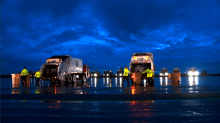
Trash Dance: Screening and Conversation
January 16, 2013 6:30 – 8:15pm 199 Lafayette Street, Third Floor New York City Just past Spring at Kenmare—and upstairs from La Esquina! A choreographer finds beauty and grace in garbage trucks and, against the odds, rallies reluctant city trash collectors to perform an extraordinary dance spectacle. On an abandoned airport runway, two dozen sanitation workers—and their […]
Read More »

The unspeakable matter
While we often post article alerts about new scholarship on garbage matters, I wanted to take a moment to re-visit Ellen Handy’s 1995 essay, “Dust Piles and Damp Pavements: Excrement, Repression, and the Victorian City in Photography and Literature.” First of all, thank you Ellen Handy for introducing readers to Thomas Annan’s enduring work (see “Dust […]
Read More »

 Discard Studies