Category Archives: Economics/Economies

The Power Behind Disposability: Why New York City’s ban on polystyrene was vilified, sued, and reversed

On July 1 New York City banned disposable Styrofoam containers. First they were sued over the decision, and last week the ban was overturned. What is the big deal? The answer, not surprisingly, is profit. Industry saves money through the creation of disposables. And disposables are only environmentally acceptable if they are recycled. Except they aren’t.
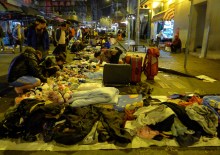
Trading on Obsolescence on the Streets of Hong Kong

The leveraging of the temporal lag between the developed and the developing world by these local street vendors enables them to generate additional value from the discarded. Second-hand goods becomes the means to access the consumer society that is characteristic of global cities.

The Value of Time and the Temporality of Value in Socialities of Waste

Drawing from long-term ethnographic research on a 25-year-old medical aid program linking the U.S. and Madagascar, I use this brief essay to trace how Malagasy and American participants engender different orientations to time through their work with discards, as they transform both discards’ value and the social relations surrounding them.

Dumpsters, difference, and illiberal embodiment

Food Not Bombs and endeavors like it, I would argue, also create the conditions to queer categories of embodiment like race, class, and sex and interrogate their privileged incorporation by prevailing markets, publics, and institutions, cultivating emergent spaces of embodiment, contact, and collaboration across difference.

Bigger, Better, Faster, More? Breaking the taboo of production

“When recycling is framed as the solution to waste problems, as it so often is in the case of e-waste, both the problem and the solution are mismatched. Recycling post-consumer commodities will do nothing to mitigate carbon dioxide emissions (or any other wastes) arising during manufacturing, long before we purchase that which we will later throwaway or recycle.” Instead, we need to look at slowing production if we want to make an impact on electronic waste.

Special Issue on Discards, Diverse Economies, and Degrowth

Why do new economic imaginaries need to take up waste as a central issue? What do novel, non-capitalist economies mean for concepts and materialities of waste?

An ethics of surplus and the right to waste?: Discards and Degrowth

What would happen if we paired an ethics of surplus, where accumulation was always temporary and not the goal of economic production, with processes of wasting that enacted social values? In this situation, we might have a right to waste.

Modern Waste is an Economic Strategy

Industry developed disposability through planned obsolescence, single-use items, cheap materials, throw-away packaging, fashion, and conspicuous consumption. American industry designed a shift in values that circulated goods through, rather than into, the consumer realm. The truism that humans are inherently wasteful came into being at a particular time and place, by design.

Misleading waste statistics

A comparison of national waste statistics shows undeniable differences between countries. However, such statistics are in many ways misleading and highlights differences that may actually not be there.

Myopic spatial politics in dominant narratives of e-waste

A new article by Josh Lepawsky argues against the popular notion that e-waste travels predominantly from ‘developed’ countries to ‘undeveloped’ countries, and what this change means for regulation and recycling practices.