Category Archives: Disease

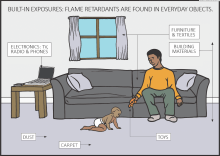
How toxic flame retardant chemicals become-and stay-ubiquitous in our homes and bodies

A new report highlights the failure of Canadian federal regulations to keep harmful flame retardant chemicals out of homes and consumer products. In fact, it argues that current regulations keep toxic chemicals *in* homes and bodies.

On Solidarity and Molecules (#MakeMuskratRight)

Deferring to molecules rather than social movements when it comes to contamination is a case of power relations.

Ethnographic Refusal: A How to Guide

Refusal is a method whereby researchers and research participants together decide not to make particular information available for use within the academy. Here are some strategies for identifying and collaborating with research refusals.

A Bibliography for Teaching Flint

This bibliography is designed for professors who want to “teach Flint” in their classrooms. The Flint, Michigan water crisis is an extreme but quintessential case study that shows the intersections of environmental health, governance, the built environment, systemic racism, and social inequity.

Thompson on Sills, ‘Toxic War: The Story of Agent Orange’

The use of the defoliant Agent Orange by the United States is one of the most controversial actions of the Vietnam War. InToxic War: The Story of Agent Orange, Peter Sills provides much-needed clarity to the history of Agent Orange with his use of data made available by legal proceedings.

Refusal as Research Method in Discard Studies

Ethnographic refusal is a practice by which researchers and research participants together decide not to make particular information available for use within the academy. Its purpose is not to bury information, but to ensure that communities are able to respond to issues on their own terms.

Piping as poison: the Flint water crisis and America’s toxic infrastructure

Over the past few decades, we have met with much success in curbing some of Americans’ exposure to lead. Yet they have struggled to contain this continuing danger precisely because it is literally built into our water systems.

DDT’s long shadow: Long-banned chemicals linked to abnormal sperm

A study of men from the Faroe Islands finds that high DDT and PCB exposure during adolescence and adulthood is associated with abnormal chromosomes in sperm. By Brian Bienkowski, EHN.

Article Alert! Attuning to the Chemosphere: Domestic Formaldehyde, Bodily Reasoning, and the Chemical Sublime

“”During the first hour spent in houses with suspected indoor air-quality issues, I would slowly develop an ache in the back of my eyes, which would with time spread throughout my skull. I repeatedly found myself struggling to resist a physical desire to expedite interviews as my mind felt increasingly woolly, my focus slipped, and my lines of inquiry lost their direction.”

New Article! The Politics of Open Defecation

This paper examines the politics of open defecation by focusing on everyday intersections of the body and infrastructure in the metabolic city, which produces profoundly unequal opportunities for fulfilling bodily needs. Specifically, it examines how open defecation emerges in Mumbai’s informal settlements through everyday embodied experiences, practices and perceptions forged in relation to the materialities of informality and infrastructure.