Category Archives: Justice (EJ)

Sweeping Away Agbogbloshie. Again.

If non-Ghanaians are aware of Old Fadama/Agbogbloshie at all it is probably as the purported largest e-waste dump on Earth. This is a drastically mistaken image. The evictions that began a few days ago are only the most recent event in a longer struggle over land rights in Accra that have nothing to do with where the ‘West’s’ e-waste goes to die.

Temporality and Waste: Slow Violence

The distribution of environmental damage in time as well as space is a key aspect of this problem, one not always recognized in the oft-invoked notion of pollution as “matter out of place.”

Sizing Up ‘Slow Violence’

If a key challenge of slow violence is how to adequately represent it so that it may be investigated, opposed, and redressed why represent its power as more formidable than it already is? There is poetry in the law, but legal personhood for corporations is not magic. It’s infrastructure.

Introduction to Rob Nixon’s Slow Violence and the Environmentalism of the Poor

Rob Nixon’s book shows how the invisible, destructive impacts of neoliberalism stretch across vast spatial and temporal scales. Within this history, profits are internalized and risks exacerbated as they are offloaded on poor communities.

Map of 40 most influential environmental justice conflicts in the US

The 40 most influential environmental justice conflicts in recent American history are now included in a Global Atlas of Environmental Justice. In the United States, decades of research have documented a strong correlation between the location of environmental burdens and the racial/ethnic background of the most impacted residents.

New Article Alert! Power, Quiescence, and Pollution: The Suppression of Environmental Grievances

There’s a new article in Social Currents by Thomas Shriver, Alison Adams, and Chris Messer, “Power, Quiescence, and Pollution The Suppression of Environmental Grievances.” It looks at the specific mechanisms by which quiescence, the state of quietness or inactivity, is fostered in the face of power inequalities around local industrial pollution.

New report on Race, Poverty, and Chemical Disasters

The report, called “Who’s in Danger? Race, Poverty, and Chemical Disasters,” sought to examine who lives in “fenceline” neighborhoods adjacent to large chemical plants. The report said those residents were more likely to be black or Latino and have lower home values, incomes and education levels than average Americans.

It Doesn’t Take a Fireman to Spot a Fire: Fighting Pollution with Citizen Science

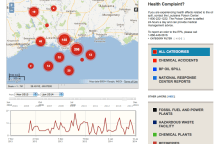
In early 2010 LABB introduced the iWitness Pollution Map to help Louisiana residents track pollution and associated health effects in their communities. Today there are over 11,000 reports of petrochemical pollution on the map. The iWitness Pollution Map is an open-source online map that allows anyone with a phone to document and share their experience with pollution via voicemail, text, email or by using the online form.

Hoarding Discourse in the Aftermath of Hurricane Sandy

A telling discourse of hoarding emerged in the immediate aftermath of the storm from relief distribution hubs that collected and freely distributed food, clothing, and other material goods to those in need. In these cases, the concept of “hoarding” highlighted the differences–and politics–between equitable and equal distributions of goods.

Grassroots Communities Mining Mini-Grant Program

In acknowledgement of growing literature and projects on mining waste, and the extreme longevity and toxicity of their legacies, here is a grant opportunity for people working in those areas: