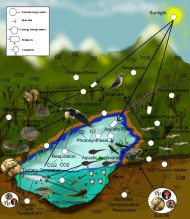
Bibliography for Critical Ecology
Since ecological metaphors, systems, and thinking are implicit to much of discard studies, we’re happy to share this crowdsourced bibliography on critical perspectives of ecology.
Since ecological metaphors, systems, and thinking are implicit to much of discard studies, we’re happy to share this crowdsourced bibliography on critical perspectives of ecology.

This is where the creative process foundational to science, fixing, and hacking come together. Rather than making more of the same, whether it’s in science or technology, the scientists, artists, and engineers at GOSH push boundaries, exceed norms, and open up possibilities. Trash is one avenue towards that goal.

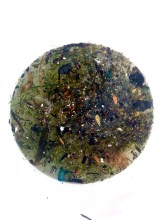
We’ve been working on the problem of making tiny, often invisible marine plastics visible through do-it-yourself (DIY) technologies. You can build your own and investigate your local environment.

If you’re interested in the history of pesticides and toxicology, Banned provides a detail-oriented, close reading of key 20th century experiments, legislative hearings, events, and texts to investigate how scientific facts and legislative decisions about pesticides were made.

The global economy produces pervasive contaminants, harmful pollutants, damaging particles, and poisonous atmospheres, which are inescapably part of everyday life, though the harms and benefits are unevenly distributed. In the face of these conditions and challenges, people have been creating new forms of politics. The following collection of abstracts highlights research projects on toxic politics, providing a snapshot of the state of the field from around the world.
Representations are the basis of human knowledge both in terms of how knowledge is made as well as how it is reproduced and circulated. They are the way reality is interpreted and conveyed for others. Our discussions about how to best convey what we’ve been researching have focused on being as clear, charismatic, and accurate as possible. We don’t want to give up accuracy to be more sensational. But we don’t want to make accurate statements that fall flat. Our goal is to do and describe science in a way that launches action that mitigates plastic pollution. How you describe a problem determines what kind of solutions make sense or not.

The road to hell is paved with good intentions. The Ocean Cleanup array, designed to clean plastics from the ocean like a baleen whale, is one of these good intentions: experts in marine plastics, including myself, say it’s a bad idea.Technological fixes like the Array do harm to the larger project of ending plastic pollution, which is a complex social, environmental, and economic problem. It is also going to damage and kill marine life.

Public Lab publishes a magazine on “cutting edge techniques in hacking environmental science” called the Grassroots Mapping Forum, and the newest edition is on waste, highlighting waste methodologies that are accessible, inexpensive, and democratic: the premises of citizen science.
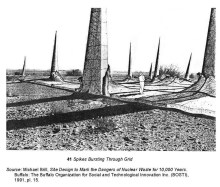
Galison argues that the categories of wastelands and wilderness are far from dichotomous; that their relation is far more intriguing (and disturbing) than a binary of purity and corruption. Removing parts of the earth in perpetuity – for reasons of sanctification or despoilment – alters a central feature of the human self, presenting us in a different relation to the physical world, and raising irreducible questions about who we are when land can be classified, forever, as not for us humans
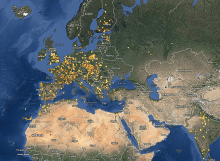
The Globe at Night project is an international citizen-science campaign to measure the impact of light pollution. It invites citizen-scientists (aka: you) to measure their night sky brightness and submit their observations from a computer or smart phone. Yet, gathering information for a scientific project is really a side effect of the goals of the project, which is to raise awareness of the problem. While my views on awareness campaigns tend toward the critical, in many ways this is a campaign for infrastructural awareness.

 Discard Studies