Category Archives: Methods

Sizing Up ‘Slow Violence’

If a key challenge of slow violence is how to adequately represent it so that it may be investigated, opposed, and redressed why represent its power as more formidable than it already is? There is poetry in the law, but legal personhood for corporations is not magic. It’s infrastructure.
A Methodology for Investigating Cityness through Waste

How do you study cityness through waste? Cityness has been used to describe both “how urban citizens give meaning to the city they live in and how this creation of meaning alters the way the city is represented” and as “an instrument to capture something that otherwise might easily get lost: types of urbanity that are non-Western.”

Grassroots Mappping: Waste

Public Lab publishes a magazine on “cutting edge techniques in hacking environmental science” called the Grassroots Mapping Forum, and the newest edition is on waste, highlighting waste methodologies that are accessible, inexpensive, and democratic: the premises of citizen science.

Speculative Historiographies of Techno-Trash

The project asks: “what if we were required to physically store and care for our personal devices, such as cell phones and desktop computers, long after these machines served their intended function? In such an imaginary, unusable technologies remain within our sights, and in our sites.” They are asking people to submit their stories.

Archaeogaming and punk archeology in discard studies

Archaeogaming is as much about exploring and conducting archaeology within gaming environments (virtual space) as it is about understanding the history of video games in the real world (meat space).
What are the frontiers in discard studies that would benefit from punk archeology?

Why Discard Studies?

People tend to think that we are familiar with waste because we deal with it every day. Yet, this is not the case. Discard studies is central to thinking through and countering the initiative aspects of waste. As more popular, policy, activist, engineering and research attention is drawn to waste it becomes crucial for the humanities and social sciences to contextualize the problems, materialities and systems of waste that are not readily apparent to the invested but casual observer. Our task is to trouble the assumptions, premises and popular mythologies of waste so that work can go in a productive direction.

Misleading waste statistics

A comparison of national waste statistics shows undeniable differences between countries. However, such statistics are in many ways misleading and highlights differences that may actually not be there.

Myopic spatial politics in dominant narratives of e-waste

A new article by Josh Lepawsky argues against the popular notion that e-waste travels predominantly from ‘developed’ countries to ‘undeveloped’ countries, and what this change means for regulation and recycling practices.

Crowdsourcing light pollution data: A means of infrastructure awareness?

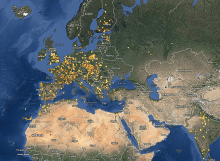
The Globe at Night project is an international citizen-science campaign to measure the impact of light pollution. It invites citizen-scientists (aka: you) to measure their night sky brightness and submit their observations from a computer or smart phone. Yet, gathering information for a scientific project is really a side effect of the goals of the project, which is to raise awareness of the problem. While my views on awareness campaigns tend toward the critical, in many ways this is a campaign for infrastructural awareness.

Questions arising from discards and ‘An Inquiry into Modes of Existence’

In effect, what I’m asking is what happens when we follow the ‘side-effects’ or discards of industry (in the literal and more metaphorical sense)? Do we bump into ‘collateral realities’ (Law, 2009) of Latour’s composed world? Do we arrive at the fractiverses of John Law (2011)? Or something else altogether? Or not at all?