Category Archives: Technology

How the Ocean Cleanup Array Fundamentally Misunderstands Marine Plastics and Causes Harm

The road to hell is paved with good intentions. The Ocean Cleanup array, designed to clean plastics from the ocean like a baleen whale, is one of these good intentions: experts in marine plastics, including myself, say it’s a bad idea.Technological fixes like the Array do harm to the larger project of ending plastic pollution, which is a complex social, environmental, and economic problem. It is also going to damage and kill marine life.

A Visit to a Waste-to-Energy Facility: Notes from central Austria’s industrial fields

“All this actually works. I mean there was so much that we didn’t know, that we still don’t know. There were so many mistakes that the industry made at the beginning. Look at Vienna, where there were some really, really bad mistakes in the 1980s. There was so much planning and preparation and calculation that went into this – and it really just works. My wish is simply for it to just be able to keep working as it has been.”

Speculative Historiographies of Techno-Trash

The project asks: “what if we were required to physically store and care for our personal devices, such as cell phones and desktop computers, long after these machines served their intended function? In such an imaginary, unusable technologies remain within our sights, and in our sites.” They are asking people to submit their stories.

Petri Dish

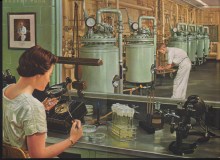
The petri dish was made for separation. As part of its ability to make separations between the contaminated world outside and the uncontaminated world inside, the dish also assisted in separating individuals from disease. These days, it’s getting harder for petri dishes to maintain these separations.

Waste-Wilderness: A Conversation between Peter Galison and Smudge Studio

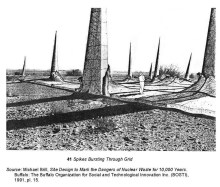
Galison argues that the categories of wastelands and wilderness are far from dichotomous; that their relation is far more intriguing (and disturbing) than a binary of purity and corruption. Removing parts of the earth in perpetuity – for reasons of sanctification or despoilment – alters a central feature of the human self, presenting us in a different relation to the physical world, and raising irreducible questions about who we are when land can be classified, forever, as not for us humans

Crowdsourcing light pollution data: A means of infrastructure awareness?

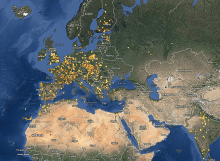
The Globe at Night project is an international citizen-science campaign to measure the impact of light pollution. It invites citizen-scientists (aka: you) to measure their night sky brightness and submit their observations from a computer or smart phone. Yet, gathering information for a scientific project is really a side effect of the goals of the project, which is to raise awareness of the problem. While my views on awareness campaigns tend toward the critical, in many ways this is a campaign for infrastructural awareness.

Questions arising from discards and ‘An Inquiry into Modes of Existence’

In effect, what I’m asking is what happens when we follow the ‘side-effects’ or discards of industry (in the literal and more metaphorical sense)? Do we bump into ‘collateral realities’ (Law, 2009) of Latour’s composed world? Do we arrive at the fractiverses of John Law (2011)? Or something else altogether? Or not at all?

It Doesn’t Take a Fireman to Spot a Fire: Fighting Pollution with Citizen Science

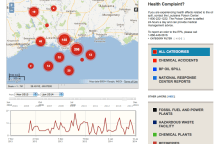
In early 2010 LABB introduced the iWitness Pollution Map to help Louisiana residents track pollution and associated health effects in their communities. Today there are over 11,000 reports of petrochemical pollution on the map. The iWitness Pollution Map is an open-source online map that allows anyone with a phone to document and share their experience with pollution via voicemail, text, email or by using the online form.

Bibliography on Noise Pollution

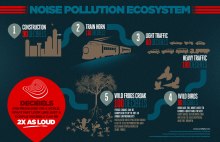
If waste is, broadly defined, the externalities of social and technical systems, then noise is a quintessential form of waste. Noise pollution is disturbing or excessive sound that may harm humans or animals, and, not surprisingly, it usually emits from industrial technologies. Perhaps because it exceeds the material fetish of most pollution laws, it wasn’t until the 1970s (1975 in Portland, to be exact) that U.S. governments promoted noise from a “nuisance” to f a full fledged environmental problem like its material cousins in the pollution panoply. Yet, noise remains a generally neglected source for the theorization of waste, pollution, and harm. If you are interested in remedying the situation, here is a bibliography for you:

Discard Studies as Science and Technology Studies (STS)

Anthropologist Mary Douglas famously states that “dirt is ‘matter out of place,'” a deeply social reaction to materials “likely to confuse or contradict cherished classifications.” In our society, we use science to determine classifications and boundaries that put materials in and out of place. That is: science is the privileged method for determining waste and pollution from non-waste and non-pollution.