
Questions arising from discards and ‘An Inquiry into Modes of Existence’
In effect, what I’m asking is what happens when we follow the ‘side-effects’ or discards of industry (in the literal and more metaphorical sense)? Do we bump into ‘collateral realities’ (Law, 2009) of Latour’s composed world? Do we arrive at the fractiverses of John Law (2011)? Or something else altogether? Or not at all?
Solutions to waste and the problem of scalar mismatches
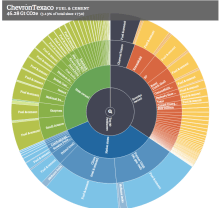
Waste advocacy and popular environmentalism suffer from a constant mismatch of scales. Problems are at one scale, and solutions are at another. This article calls for shift in cultural discourses that include proportion and scale so that information, problem identification, and proposed solutions are able to intervene into problems in meaningful and effective ways.

A Taxonomy of Unformed Objects
What is it about our present—what forces, what infrastructures of global capital, conditions of planetary climate change, non-innocent affective economics—that provokes so many scholars to find the unformed phenomena, the phenomena open to change and already altered, everywhere?

Damage Control: Art and Destruction since 1950 @ The Hirshhorn Museum
The Hirshhorn Museum & Sculpture Garden in Washington, DC, is showing Damage Control: Art and Destruction since 1950 until May 2014.
It Doesn’t Take a Fireman to Spot a Fire: Fighting Pollution with Citizen Science
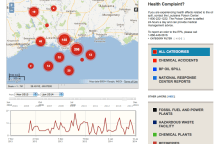
In early 2010 LABB introduced the iWitness Pollution Map to help Louisiana residents track pollution and associated health effects in their communities. Today there are over 11,000 reports of petrochemical pollution on the map. The iWitness Pollution Map is an open-source online map that allows anyone with a phone to document and share their experience with pollution via voicemail, text, email or by using the online form.

Against Awareness, For Scale: Garbage is Infrastructure, Not Behavior
The journey from awareness to behavior change is a long and arduous one, and few make it. Even for those who change their behavior, the scale of the change is often too small to impact the problem at hand. So what do we do?

Special issue of Bulletin of the Atomic Scientists: Destruction, Art, and the Doomsday Clock
In this special issue of the Bulletin of the Atomic Scientists, authors reflect on how, when and why art has been used to articulate destruction over the past decades. Their essays are a glimpse into the topics that were recently discussed at the 2013 Doomsday Clock Symposium in Washington, DC.

San Francisco’s Famous 80% Waste Diversion Rate: Anatomy of an Exemplar
Despite San Francisco’s 80% diversion rate, the average person sends about 2.7 pounds per day to landfills. On a per person basis, it would seem that record-setting San Franciscans send roughly the same quantities to the dump as their friends in other places in the US. Samantha MacBride explains the logics behind these statistics.
A Review of Infrapolitics: The Social Life of Water in Mumbai
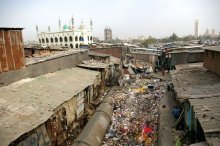
This review of Nikhil Anand’s dissertation, Infrapolitics: The Social Life of Water in Mumbai, written by Tarini Bedi, will be of interest to discard studies scholars because of the methodological approach and how it highlights the politics of infrastructure.

The visual culture of post-disaster high water marks
f you look at enough photographs of disasters, you will see people posing with high water marks. It is a genre of photography onto itself: over and over, they will point to the mark, put their bodies in front of the mark, or photograph the high water line alone. This post explores the possible roles that the visual culture of post-disaster high water marks play, especially given the prevalence of the genre across disasters, geography, and time.

 Discard Studies