Author Archives: Max Liboiron

Article Alert- Dispossession by Accumulation

Antipode has published Tom Perreault’s “Dispossession by Accumulation? Mining, Water and the Nature of Enclosure on the Bolivian Altiplano.” The article is noteworthy not only because it discusses some of the objects of discard studies–namely, pollution– but also because it figures industrial discards as a form of accumulation. The accumulation in question is capitalistic primitive accumulation […]
Read More »

Trash is a Wicked Problem

By Max Liboiron One person’s trash is another person’s treasure. Waste is inherently ambivalent. It is both worthless and the basis for a billion dollar, recession-proof industry, complete with cartels and multinational companies. Disgust with filth both reaffirms our identities and troubles us. But a plethora of contradictory terms and values is not what makes […]
Read More »

Recycled Artist in Residency campaign coming to a close, but residencies to kick off in earnest

RAIR (Recycled Artist in Residency) is a young yet accomplished project located within a construction waste recycling center in Philadelphia. They have twelve hours left in a fundraising campaign to open the trash-stream residency program to applications from artists in the Spring of 2013.  They hope to hire staff with the money and become a […]
Read More »

Discard Studies and the Nonhuman

Guest post by Josh Lepawsky Have we students of discard studies given sufficient thought to the nonhuman? The nonhuman in the form of materiality and the agencies of things is certainly a prevalent theme in the multiplying and ramifying work constituting discard studies. But there is, of course, more to the nonhuman than ‘stuff’ and […]
Read More »

Waste and Capitalism

Last night’s presentation of Surveying Waste and Capital at Trade School (NYC), lead by CUNY doctoral candidate Jesse Goldstein included a historical narrative starting in England during the enclosure movement and how the “wasteland,” originally referring to productive pasture and foraging land on the outskirts of a village’s agricultural fields, was reframed as “wasted spaces” […]
Read More »

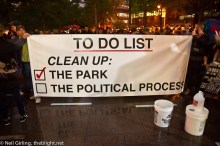
Tactics of Waste, Dirt and Discard in the Occupy Movement: A Photo Essay

By Max Liboiron It has been one week since the one year anniversary of Occupy Wall Street, September 17, 2012. In celebration, let’s look at the movement through the lens of discard studies. My article, “Tactics of Waste, Dirt and Discard in the Occupy Movement“, has just appeared in Social Movement Studies: Journal of Social, […]
Read More »

Recycling as a Crisis of Meaning

This article was originally published by Max Liboiron in eTOPIA: Canadian Journal of Cultural Studies, Spring 2010. In laymen’s terms, recycling is “good for the environment.” It involves “doing your bit” to help “save the Earth.” Yet recycling requires high expenditures of energy and virgin materials, and produces pollutants, greenhouse gases and waste; it creates […]
Read More »

CFP: History and Cultural Representations of Human Remains

Call for Papers: History and Cultural Representations of Human Remains Conferences Medical Museums and Anatomic Collections at the Natural History Museum, Toulouse, on 4 February, 2013 Anatomic Models at the Academy of Medicine, Paris, on 4 April, 2013 Exhibiting Human Remains at the Hunterian Museum, London, on 4 June, 2013 Although modern anatomy owes a […]
Read More »

Designing a Reuse Symbol and the Challenge of Recycling’s Legacy

By Max Liboiron The “universal” recycling symbol was designed in 1970 for a competition during America’s first Earth Day. A large producer of recycled paperboard, the Container Corporation of America, sponsored the competition. The winner was Gary Anderson, an urban design student in California, who said that he designed the symbol as a Mobius strip, […]
Read More »

Article Alert-Tactics of Waste, Dirt and Discard in the Occupy Movement

Currently “Tactics of Waste, Dirt and Discard in the Occupy Movement” is published as a forthcoming article in Social Movement Studies: Journal of Social, Cultural and Political Protest, but will soon be part of a special issue on the Occupy movement. From August until September, the special issue will have free and open access. When […]
Read More »