Category Archives: Environment

Introduction to Rob Nixon’s Slow Violence and the Environmentalism of the Poor

Rob Nixon’s book shows how the invisible, destructive impacts of neoliberalism stretch across vast spatial and temporal scales. Within this history, profits are internalized and risks exacerbated as they are offloaded on poor communities.
Researcher Activism: The Gutting of Discard Science in Canada and the Write2Know Campaign

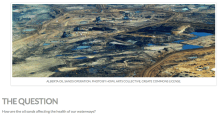
Being able to identify the materials in waste, its location, and its effects are the first steps in making decisions about waste. But all three of those abilities have been “gutted” by the Canadian federal government’s “war on science.”

Special Issue on International Chemicals Regulation Following the Minamata Convention

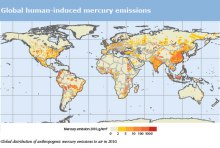
Legal frameworks are one main way through which chemicals are defined: terms of harm, responsibility, and circulation, some of the defining features of pollution, are debated, agreed upon, and codified in legal forums. The Minamanta Convention on Mercury is the first environmental agreement in a decade to set these terms across nations.

A Cabinet of Curiosities for the Anthropocene

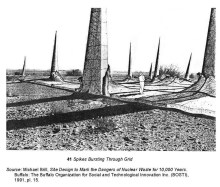
The Anthropocene is just one among many moments in time when new scientific objects have altered humanity’s relationship to the past, present, and future. Scientific objects such as fossils, radioactivity, genetic mutations, toxic pesticides, and ice cores, to name a few, have precipitated different narratives and imaginings of the human past and the human future. What might a cabinet of curiosities for the age of the Anthropocene look like?

The Rare Earth Catalog (and Research Group): Tools for Reckoning with the Anthropocene

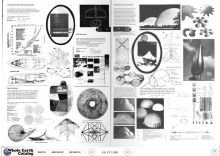
The Rare Earth Catalog will be a repository of tools: from the critical, to the conceptual, to the practical, that can help us resist, rework, redefine, and remember the interconnections of our socio-ecological present. We are seeking collaborators to help us envision and ultimately produce the Catalog. We are also interested in receiving contributions of (short) texts and images that connect specific examples of climate-change related politics and processes to a wide range of themes, including waste, fixing, and pollution.

New report on Race, Poverty, and Chemical Disasters

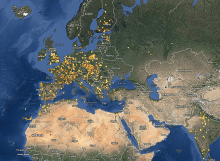
The report, called “Who’s in Danger? Race, Poverty, and Chemical Disasters,” sought to examine who lives in “fenceline” neighborhoods adjacent to large chemical plants. The report said those residents were more likely to be black or Latino and have lower home values, incomes and education levels than average Americans.

Waste-Wilderness: A Conversation between Peter Galison and Smudge Studio

Galison argues that the categories of wastelands and wilderness are far from dichotomous; that their relation is far more intriguing (and disturbing) than a binary of purity and corruption. Removing parts of the earth in perpetuity – for reasons of sanctification or despoilment – alters a central feature of the human self, presenting us in a different relation to the physical world, and raising irreducible questions about who we are when land can be classified, forever, as not for us humans

Crowdsourcing light pollution data: A means of infrastructure awareness?

The Globe at Night project is an international citizen-science campaign to measure the impact of light pollution. It invites citizen-scientists (aka: you) to measure their night sky brightness and submit their observations from a computer or smart phone. Yet, gathering information for a scientific project is really a side effect of the goals of the project, which is to raise awareness of the problem. While my views on awareness campaigns tend toward the critical, in many ways this is a campaign for infrastructural awareness.

Solutions to waste and the problem of scalar mismatches

Waste advocacy and popular environmentalism suffer from a constant mismatch of scales. Problems are at one scale, and solutions are at another. This article calls for shift in cultural discourses that include proportion and scale so that information, problem identification, and proposed solutions are able to intervene into problems in meaningful and effective ways.

It Doesn’t Take a Fireman to Spot a Fire: Fighting Pollution with Citizen Science

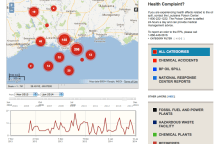
In early 2010 LABB introduced the iWitness Pollution Map to help Louisiana residents track pollution and associated health effects in their communities. Today there are over 11,000 reports of petrochemical pollution on the map. The iWitness Pollution Map is an open-source online map that allows anyone with a phone to document and share their experience with pollution via voicemail, text, email or by using the online form.