Category Archives: Labor

Grassroots Mappping: Waste

Public Lab publishes a magazine on “cutting edge techniques in hacking environmental science” called the Grassroots Mapping Forum, and the newest edition is on waste, highlighting waste methodologies that are accessible, inexpensive, and democratic: the premises of citizen science.
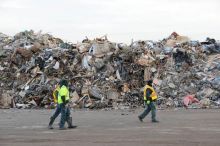
Commissioner of NYC’s Department of Sanitation on Hurricane Sandy

The following is a statement by John Doherty, Commissioner of the New York City Department of Sanitation, about the department’s response to Hurricane Sandy.

Waste-Wilderness: A Conversation between Peter Galison and Smudge Studio

Galison argues that the categories of wastelands and wilderness are far from dichotomous; that their relation is far more intriguing (and disturbing) than a binary of purity and corruption. Removing parts of the earth in perpetuity – for reasons of sanctification or despoilment – alters a central feature of the human self, presenting us in a different relation to the physical world, and raising irreducible questions about who we are when land can be classified, forever, as not for us humans

Crowdsourcing light pollution data: A means of infrastructure awareness?

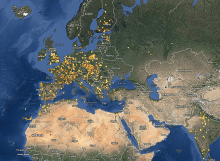
The Globe at Night project is an international citizen-science campaign to measure the impact of light pollution. It invites citizen-scientists (aka: you) to measure their night sky brightness and submit their observations from a computer or smart phone. Yet, gathering information for a scientific project is really a side effect of the goals of the project, which is to raise awareness of the problem. While my views on awareness campaigns tend toward the critical, in many ways this is a campaign for infrastructural awareness.

It Doesn’t Take a Fireman to Spot a Fire: Fighting Pollution with Citizen Science

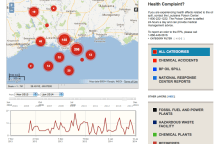
In early 2010 LABB introduced the iWitness Pollution Map to help Louisiana residents track pollution and associated health effects in their communities. Today there are over 11,000 reports of petrochemical pollution on the map. The iWitness Pollution Map is an open-source online map that allows anyone with a phone to document and share their experience with pollution via voicemail, text, email or by using the online form.

Special issue of Bulletin of the Atomic Scientists: Destruction, Art, and the Doomsday Clock

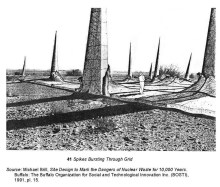
In this special issue of the Bulletin of the Atomic Scientists, authors reflect on how, when and why art has been used to articulate destruction over the past decades. Their essays are a glimpse into the topics that were recently discussed at the 2013 Doomsday Clock Symposium in Washington, DC.

Sanitation Workers: Hurricane Sandy’s First Responders

“We were the first ones there. And not only were we the first; we were the best. You know? We were the first responders in areas that nobody knew about– like I went to Sheepshead Bay and Arlene Avenue. It’s strange because if you’re driving up and down it, you wouldn’t notice them. But there were maybe a couple of dozen small houses. Nobody else knew they were down there. Our sanitation guys knew where every little nook and cranny was.”

Tales from Our Trash: Sanitation Workers, Sustainable Cities, and the Value of Knowledge

Held in honor of Frank Justich, a NYC Sanitation worker killed on the job in Astoria in 2010, the event will feature a discussion with Professor Robin Nagle (author of Picking Up, and the anthropologist-in-residence with the NYC Department of Sanitation), as well as presentations by the NYC Commissioner of Sanitation, John Dougherty, and conceptual artist, Mierle Laderman Ulekes (artist-in-residence with the NYC Department of Sanitation), and youth activists representing future generations. The event is the first in CUER’s planned series focusing on trash as a lens for considering issues of sustainability. The focus of the evening’s conversation will be on trash as an issue of inter-generational equity, and the need to recognize sanitation workers as the front line of urban sustainability.

Discard Studies as Science and Technology Studies (STS)

Anthropologist Mary Douglas famously states that “dirt is ‘matter out of place,'” a deeply social reaction to materials “likely to confuse or contradict cherished classifications.” In our society, we use science to determine classifications and boundaries that put materials in and out of place. That is: science is the privileged method for determining waste and pollution from non-waste and non-pollution.

A history of New York City’s solid waste management in photographs

By the nineteenth century, New York City was persistently and famously filthy. While other urban centers had begun to clean up their streets, approaching vessels could still smell New York far out to sea. Yet,  the Department of Sanitation (DSNY) was founded in 1881 as the Department of Street Cleaning and became one of the […]
Read More »