Category Archives: science and scientists

It Doesn’t Take a Fireman to Spot a Fire: Fighting Pollution with Citizen Science

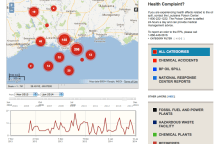
In early 2010 LABB introduced the iWitness Pollution Map to help Louisiana residents track pollution and associated health effects in their communities. Today there are over 11,000 reports of petrochemical pollution on the map. The iWitness Pollution Map is an open-source online map that allows anyone with a phone to document and share their experience with pollution via voicemail, text, email or by using the online form.


Special issue of Bulletin of the Atomic Scientists: Destruction, Art, and the Doomsday Clock

In this special issue of the Bulletin of the Atomic Scientists, authors reflect on how, when and why art has been used to articulate destruction over the past decades. Their essays are a glimpse into the topics that were recently discussed at the 2013 Doomsday Clock Symposium in Washington, DC.

Discard Studies as Science and Technology Studies (STS)

Anthropologist Mary Douglas famously states that “dirt is ‘matter out of place,'” a deeply social reaction to materials “likely to confuse or contradict cherished classifications.” In our society, we use science to determine classifications and boundaries that put materials in and out of place. That is: science is the privileged method for determining waste and pollution from non-waste and non-pollution.

Body Burdens, Biomonitoring, and Biocitizenship

By Max Liboiron, Lindsey Dillon, and submitting authors. Since at least the publication of Silent Spring, scientists, policy-makers, and the general public has focused on pollution in the environment as the object of regulation and control, a source of fear and anxiety, and the subject of scientific testing. As technologies, analytical detection limits, and eco-populist, […]
Read More »

One million years of isolation: an interview with Abraham Van Luik

Edited by Elizabeth Ellsworth and Jamie Kruse, Making the Geologic Now, has many entries on waste. Perhaps this is not surprising, since many of what Samantha MacBride calls “modern wastes,” characterized by their synthetic nature, unpredictability, and heterogeneity, are also permanent. From plastics to e-waste, industrially-generated waste now lasts in geological time rather than evolutionary […]
Read More »

Shoes and ducks: pollutants as “proper” boundary objects

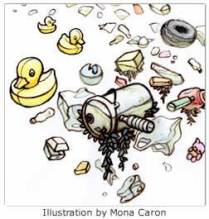
By Max Liboiron. In 1990, a sudden storm knocked twenty-one containers from a cargo vessel into the sea. Five contained 78,932 Nike shoes. The event was kept quiet by both the shipping company and Nike, but when hundreds of shoes began washing up on the shores of Vancouver Island in Canada, eight months later, beachcombers, […]
Read More »