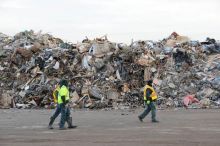
Commissioner of NYC’s Department of Sanitation on Hurricane Sandy
The following is a statement by John Doherty, Commissioner of the New York City Department of Sanitation, about the department’s response to Hurricane Sandy.
The following is a statement by John Doherty, Commissioner of the New York City Department of Sanitation, about the department’s response to Hurricane Sandy.
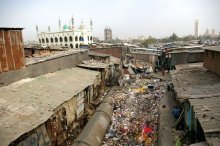
This review of Nikhil Anand’s dissertation, Infrapolitics: The Social Life of Water in Mumbai, written by Tarini Bedi, will be of interest to discard studies scholars because of the methodological approach and how it highlights the politics of infrastructure.

“We were the first ones there. And not only were we the first; we were the best. You know? We were the first responders in areas that nobody knew about– like I went to Sheepshead Bay and Arlene Avenue. It’s strange because if you’re driving up and down it, you wouldn’t notice them. But there were maybe a couple of dozen small houses. Nobody else knew they were down there. Our sanitation guys knew where every little nook and cranny was.”
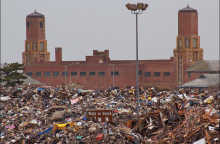
Not only do natural (and unnatural) disasters produce a lot of waste, they are also extreme but oddly quintessential events where practices, behavior, and cultures around waste and wasting, as well as their inverse–repairing, fixing, rebuilding–move to the fore. In the weeks proceeding and following the one year anniversary of Hurricane Sandy making landfall in New York City and surrounding area, Discard Studies will feature a series of articles about the complexities of disaster and waste, broadly defined. This article looks at the material and emotional nature of waste during disaster.

Held in honor of Frank Justich, a NYC Sanitation worker killed on the job in Astoria in 2010, the event will feature a discussion with Professor Robin Nagle (author of Picking Up, and the anthropologist-in-residence with the NYC Department of Sanitation), as well as presentations by the NYC Commissioner of Sanitation, John Dougherty, and conceptual artist, Mierle Laderman Ulekes (artist-in-residence with the NYC Department of Sanitation), and youth activists representing future generations. The event is the first in CUER’s planned series focusing on trash as a lens for considering issues of sustainability. The focus of the evening’s conversation will be on trash as an issue of inter-generational equity, and the need to recognize sanitation workers as the front line of urban sustainability.

By the nineteenth century, New York City was persistently and famously filthy. While other urban centers had begun to clean up their streets, approaching vessels could still smell New York far out to sea. Yet, the Department of Sanitation (DSNY) was founded in 1881 as the Department of Street Cleaning and became one of the […]
Read More »

For Sendhil, it’s all about keeping the trucks coming in at the right time, at the right pace. “If work stops here, then they’ll be a line of trucks waiting, people’s trash won’t get picked up. So, we just have to make sure everything keeps going.” Thus, he’s not concerned about segregation, or recycling. What he needs are good roads, infrastructure, he says. Only with that can they keep pushing the trash away from the houses, and prevent “incidents” like the small fires that break out on occasion.

Discard Studies has created a new resource page for dissertations and thesis related to the field. The partial review below is taken from Dissertation Reviews, a relatively new online publishing venue for freshly minted research (we highly recommend new graduates submit their work). If you would like your or your advisee’s dissertation on the Discard […]
Read More »
By Max Liboiron. “When I got to get the stuff in the bucket, first I go down the far left edge of the pile, dump it in. Then I go down the far right side of the pile, dump it in. Then I go down the middle. So everything fits in the back of the […]
Read More »

Reblogged from our friends at the fantastic Material World Blog. Aliine Lotman (Anthro Dept, EHI, Tallinn University) “Until the 19th century, the term ‘to consume’ was used mainly in its negative connotations of ‘destruction’ and ‘waste’. Tuberculosis was known as ‘consumption’, that is, a wasting disease. Then economists came up with a bizarre theory, which […]
Read More »

 Discard Studies