Category Archives: toxicity

Thompson on Sills, ‘Toxic War: The Story of Agent Orange’

The use of the defoliant Agent Orange by the United States is one of the most controversial actions of the Vietnam War. InToxic War: The Story of Agent Orange, Peter Sills provides much-needed clarity to the history of Agent Orange with his use of data made available by legal proceedings.


Refusal as Research Method in Discard Studies

Ethnographic refusal is a practice by which researchers and research participants together decide not to make particular information available for use within the academy. Its purpose is not to bury information, but to ensure that communities are able to respond to issues on their own terms.

Toxic Symposium on Exposure, Entanglement, and Endurance: A Summary in Tweets

Toxics: A Symposium on Exposure, Entanglement, and Endurance was heralded as “the most important conversation on body burdens yet.” See the Twitter version of that conversation here.

Piping as poison: the Flint water crisis and America’s toxic infrastructure

Over the past few decades, we have met with much success in curbing some of Americans’ exposure to lead. Yet they have struggled to contain this continuing danger precisely because it is literally built into our water systems.

DDT’s long shadow: Long-banned chemicals linked to abnormal sperm

A study of men from the Faroe Islands finds that high DDT and PCB exposure during adolescence and adulthood is associated with abnormal chromosomes in sperm. By Brian Bienkowski, EHN.

Roundtable reviews of “Banned: A History of Pesticides and the Science of Toxicology”

If you’re interested in the history of pesticides and toxicology, Banned provides a detail-oriented, close reading of key 20th century experiments, legislative hearings, events, and texts to investigate how scientific facts and legislative decisions about pesticides were made.

The Power Behind Disposability: Why New York City’s ban on polystyrene was vilified, sued, and reversed

On July 1 New York City banned disposable Styrofoam containers. First they were sued over the decision, and last week the ban was overturned. What is the big deal? The answer, not surprisingly, is profit. Industry saves money through the creation of disposables. And disposables are only environmentally acceptable if they are recycled. Except they aren’t.

Toxic Politics: A Collection of Research Projects

The global economy produces pervasive contaminants, harmful pollutants, damaging particles, and poisonous atmospheres, which are inescapably part of everyday life, though the harms and benefits are unevenly distributed. In the face of these conditions and challenges, people have been creating new forms of politics. The following collection of abstracts highlights research projects on toxic politics, providing a snapshot of the state of the field from around the world.

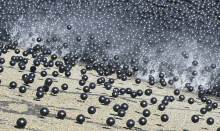
LA’s Shade Balls: The ecological costs of plastics in water

Putting 20,000 black plastic balls in water after people have been warned against throwing plastic into waterways has sparked a number of questions. Our plastic expert talks about what happens when water meets plastic:

Article Alert! Attuning to the Chemosphere: Domestic Formaldehyde, Bodily Reasoning, and the Chemical Sublime

“”During the first hour spent in houses with suspected indoor air-quality issues, I would slowly develop an ache in the back of my eyes, which would with time spread throughout my skull. I repeatedly found myself struggling to resist a physical desire to expedite interviews as my mind felt increasingly woolly, my focus slipped, and my lines of inquiry lost their direction.”