Category Archives: Nuclear

When Deep Time Becomes Shallow: Knowing Nuclear Waste Risk Ethnographically

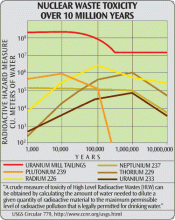
When reflecting on these intertwined day-to-day, multi-decade, centurial, and multi-millennial horizons of nuclear waste risk all at the same time, a different set of sensibilities emerges. Namely, it becomes evident how relatively short-term events like unanticipated deaths, retirements of key experts, obsolescence of information storage technologies, and surprise career-changes can potentially shake nuclear waste management projects’ stabilities.

Location, location, location: why South Australia could take the world’s nuclear waste

South Australia’s Nuclear Fuel Cycle Royal Commission has recommended the state investigate an international storage site for intermediate and high-level (spent fuel) nuclear waste.

Drawing the Invisible: An interview with the illustrator for the Radiation Monitoring Project

Communicating invisible threats is an area of interest in discard studies because it requires distilling and articulating the ideas that matter most in our concepts of contamination and harm. I asked Yuko some questions about the background and choices behind the images for the Radiation Monitoring Project.

Dumpster Diving at the World’s Largest Particle Accelerator

This is where the creative process foundational to science, fixing, and hacking come together. Rather than making more of the same, whether it’s in science or technology, the scientists, artists, and engineers at GOSH push boundaries, exceed norms, and open up possibilities. Trash is one avenue towards that goal.

Waste-Wilderness: A Conversation between Peter Galison and Smudge Studio

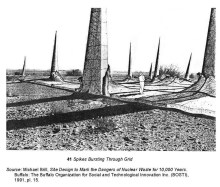
Galison argues that the categories of wastelands and wilderness are far from dichotomous; that their relation is far more intriguing (and disturbing) than a binary of purity and corruption. Removing parts of the earth in perpetuity – for reasons of sanctification or despoilment – alters a central feature of the human self, presenting us in a different relation to the physical world, and raising irreducible questions about who we are when land can be classified, forever, as not for us humans

Special issue of Bulletin of the Atomic Scientists: Destruction, Art, and the Doomsday Clock

In this special issue of the Bulletin of the Atomic Scientists, authors reflect on how, when and why art has been used to articulate destruction over the past decades. Their essays are a glimpse into the topics that were recently discussed at the 2013 Doomsday Clock Symposium in Washington, DC.

Communicating Eternity: A Typological Guide to America’s Ephemeral Nuclear Infrastructure

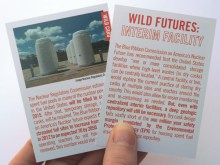
By Max Liboiron We all know waste doesn’t go “away.” We know about landfills, transfer stations, blue boxes, and ocean plastics. We know special types of waste, such as nuclear waste, has similar infrastructure, but imagine that infrastructure is somewhere “away.” Or is it? Repository: A Typological Guide to America’s Ephemeral Nuclear Infrastructure,is a 42-card […]
Read More »

Geological Garbage

Verlyn Klinkenborg’s recent article, “After the Great Quake, Living with Earth’s Uncertainty” is about how the earthquake and tsunami in Japan “remind us that we exist in geologic time.” He links the earthquake and its aftermath with climate change, saying, “[a]s we watch the specter of climate change unfold — trying to grasp the shifting, […]
Read More »

…But Where Do We Put It?

It’s always been a doozy of a discard problem: where to put radioactive waste? How to make it inert — and keep it that way? It exemplifies the essential dilemma created by so many categories of our discards: how can it be contained? Recent developments at the Hanford Site, which covers 586 square miles in […]
Read More »