Category Archives: Consumption

Against Awareness, For Scale: Garbage is Infrastructure, Not Behavior

The journey from awareness to behavior change is a long and arduous one, and few make it. Even for those who change their behavior, the scale of the change is often too small to impact the problem at hand. So what do we do?

San Francisco’s Famous 80% Waste Diversion Rate: Anatomy of an Exemplar

Despite San Francisco’s 80% diversion rate, the average person sends about 2.7 pounds per day to landfills. On a per person basis, it would seem that record-setting San Franciscans send roughly the same quantities to the dump as their friends in other places in the US. Samantha MacBride explains the logics behind these statistics.

Hoarding Discourse in the Aftermath of Hurricane Sandy

A telling discourse of hoarding emerged in the immediate aftermath of the storm from relief distribution hubs that collected and freely distributed food, clothing, and other material goods to those in need. In these cases, the concept of “hoarding” highlighted the differences–and politics–between equitable and equal distributions of goods.

Review: The City Recycled: The Afterlives of Demolished Buildings in Post-war Beijing

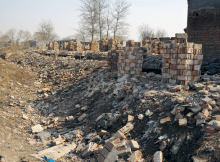
Shih-yang Kao’s dissertation on demolition waste in Beijing provides rich material for scholars interested in the players involved in urban-rural discard commodity chains. While post-demolition waste was considered a resource for both socialist (1949-1978) and reform era (1978-present) governments, The City Recycled: The Afterlives of Demolished Buildings in Post-war Beijing narrates how values of waste shifted for each period, as well as how it continues to shift under different present-day policies, geographical locations, regional and local economies, and stakeholder groups.

Chennai Waste, Part 1: Informally tracking the trash in Mylapore

By Ashwini Srinivasamoha. Chennai, the Indian state capital of Tamil Nadu, is the sixth most populous city in India, and is located on the southeast coast of India. One of the most severe environmental and public health issues facing Chennai is waste, and is currently managed through two refuse dumps, receiving over 5,000 tons of […]
Read More »

A review of The Perfect Food and the Filth Disease: Milk, Typhoid Fever, and the Science of State Medicine in Victorian Britain, 1850-1900

Discard Studies has created a new resource page for dissertations and thesis related to the field. The partial review below is taken from Dissertation Reviews, a relatively new online publishing venue for freshly minted research (we highly recommend new graduates submit their work). If you would like your or your advisee’s dissertation on the Discard […]
Read More »

Accumulation: The Material Politics of Plastic

The newly published edited collection Accumulation: The Material Politics of Plastic explores the material politics of plastics. From food packaging to credit cards, plastic facilitates every part of our daily lives, and stars a central role in discard debates. Universalised and abstracted, it is often treated as the passive object of political deliberations, or a […]
Read More »

Waste as Profit & Alternative Economies

*This is an edited transcript from the IDEAS City lecture on waste by Max Liboiron. Modern waste—that is, mid-20th to 21st century waste—is characterized by a few things. First, there is its tonnage– there is a lot of it, mostly industrial. About 98 percent of waste produced in the United States is industrial solid waste, […]
Read More »

We Need a Fixer (Not Just a Maker) Movement By Clive Thompson

This post originally appeared on Wired Opinion 06.18.13. Madison Sheffield cracks open a toaster oven, jams her hand inside, then turns on the power. It looks like she’s about to electrocute herself, but she seems unfazed. “Thermostat or heating element?” Sheffield mutters, yanking on wires and poking around with a multimeter. “Why isn’t this working?” […]
Read More »

Shifting the Burden of Recycling: Yale Journal Explores the State of Extended Producer Responsibility

Via Reid Lifset, editor of Journal of Industrial Ecology (JIE): Over the past two decades governments around the world have been experimenting with a new strategy for managing waste.  By making producers responsible for their products when they become wastes, policy makers seek to significantly increase the recycling­-and recyclability­-of computers, packaging, automobiles, and household hazardous […]
Read More »