Category Archives: Methods

Solutions to waste and the problem of scalar mismatches

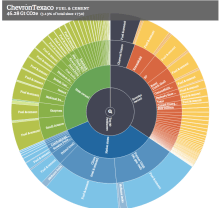
Waste advocacy and popular environmentalism suffer from a constant mismatch of scales. Problems are at one scale, and solutions are at another. This article calls for shift in cultural discourses that include proportion and scale so that information, problem identification, and proposed solutions are able to intervene into problems in meaningful and effective ways.

It Doesn’t Take a Fireman to Spot a Fire: Fighting Pollution with Citizen Science

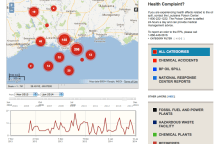
In early 2010 LABB introduced the iWitness Pollution Map to help Louisiana residents track pollution and associated health effects in their communities. Today there are over 11,000 reports of petrochemical pollution on the map. The iWitness Pollution Map is an open-source online map that allows anyone with a phone to document and share their experience with pollution via voicemail, text, email or by using the online form.

Against Awareness, For Scale: Garbage is Infrastructure, Not Behavior

The journey from awareness to behavior change is a long and arduous one, and few make it. Even for those who change their behavior, the scale of the change is often too small to impact the problem at hand. So what do we do?

San Francisco’s Famous 80% Waste Diversion Rate: Anatomy of an Exemplar

Despite San Francisco’s 80% diversion rate, the average person sends about 2.7 pounds per day to landfills. On a per person basis, it would seem that record-setting San Franciscans send roughly the same quantities to the dump as their friends in other places in the US. Samantha MacBride explains the logics behind these statistics.

A Review of Infrapolitics: The Social Life of Water in Mumbai

This review of Nikhil Anand’s dissertation, Infrapolitics: The Social Life of Water in Mumbai, written by Tarini Bedi, will be of interest to discard studies scholars because of the methodological approach and how it highlights the politics of infrastructure.

Discard Studies as Science and Technology Studies (STS)

Anthropologist Mary Douglas famously states that “dirt is ‘matter out of place,'” a deeply social reaction to materials “likely to confuse or contradict cherished classifications.” In our society, we use science to determine classifications and boundaries that put materials in and out of place. That is: science is the privileged method for determining waste and pollution from non-waste and non-pollution.

Review: The City Recycled: The Afterlives of Demolished Buildings in Post-war Beijing

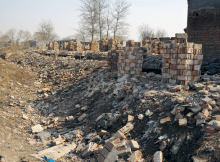
Shih-yang Kao’s dissertation on demolition waste in Beijing provides rich material for scholars interested in the players involved in urban-rural discard commodity chains. While post-demolition waste was considered a resource for both socialist (1949-1978) and reform era (1978-present) governments, The City Recycled: The Afterlives of Demolished Buildings in Post-war Beijing narrates how values of waste shifted for each period, as well as how it continues to shift under different present-day policies, geographical locations, regional and local economies, and stakeholder groups.

The Decompository at the Arnold Arboretum

Most Arboretums don’t put their dirt, waste, and decomposition on visitor maps. In July, via a workshop on Digital STS at Boston’s Arnold Arboretum, we fixed that. We created “The Decompository” for the Arboretum. The Decompository cataloged the entire, often dirty, frequently smelly, certainly decomposing urban ecology of the park could be made more apparent for visitors and researchers.

Methodologies: How to Read a Landscape

Discard studies are often entwined with landscapes. Ruins, environmental contamination, xenogarbology (the study of trash in space), ocean plastics, global e-waste flows, and urban waste are all place or space contingent. Thus, reading landscapes can be a valuable methodology for us. A fantastic example is the landscape ethnography Beyond Passaic: Contamination, security threats, hobo encampments. A […]
Read More »

‘Detritivore’ Design: How to Use Trash to Create Scalable Tech Solutions- Mathew Lippincott

Guest post by Mathew Lippincott. Originally posted on Mediashift’s Idea Lab. Detritivores are creatures that consume decaying matter. Detritivore designs use abundant waste products to make scalable technology solutions. Unlike loftier concepts of zero-waste design such as Cradle to Cradle, Detritivore design accepts that the world is already loaded with discarded and broken technology. Detritivore designers need […]
Read More »