
When your research is attacked
Attacks on research have become routinized and institutionalized. Here is our step-by-step guide on what to do if you and your research are attacked.
Attacks on research have become routinized and institutionalized. Here is our step-by-step guide on what to do if you and your research are attacked.

What are the most frequently read articles on Discard Studies? You might be surprised by #1!

We tend to think that we are familiar with waste because we deal with it every day. Yet, this is not the case–most aspects of waste are entirely hidden from view and understanding.

Dear Discard Studies Readers, I have been posting on this blog every week for the past seven years. It has been a pleasure. I began as a PhD student under Robin Nagle, who founded this blog in 2010, and am now in my third year as an assistant professor. The blog began with a model […]
Read More »

After riding along with Bill that day, I started wondering about the morality of turning dead deer into “zoological garbage.”[3] If how we treat the dead influences how we treat the living, then the most obvious question is whether this is a respectful way to treat the dead.
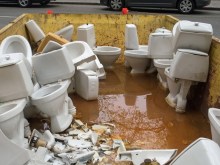
By Susan Ross Construction, renovation, and demolition (CR&D) waste can represent from 30 to 50% of municipal solid waste (Yeheyis et al, 2013). Yet this area of discard studies seems chronically understudied. Susan Ross, Assistant Professor at Carleton University, Canada, provides an extended bibliography on the topic, with a focus on one aspect of demolition […]
Read More »

By Susan Ross Building deconstruction refers to the careful taking apart of a building to salvage its reusable materials and components. These are either stored on site for short-term integration in a new design, or removed to a salvage yard for use at a later date. Whereas prevailing mechanical demolition creates mounds of unsorted debris […]
Read More »

These are admirable initiatives, but they only reduce wastage or delay garments from ending up in landfill. They do not address the fact that the scale of fast fashion is so massive it can easily eclipse other sustainability initiatives.

A trench amphipod, Hirondellea gigas, from the deepest place on Earth: Challenger Deep in the Mariana Trench (10,890m). Alan Jamieson, Newcastle University, Author provided Alan Jamieson, Newcastle University Even animals from the deepest places on Earth have accumulated pollutants made by humans. That’s the unfortunate finding of a new study by myself with colleagues from […]
Read More »

Are you an artist, musician, hacker, tinkerer, or generally a curious person, between 18 and 24 years?

 Discard Studies