Category Archives: history

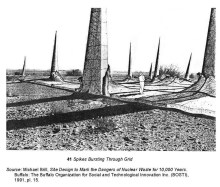
Waste-Wilderness: A Conversation between Peter Galison and Smudge Studio

Galison argues that the categories of wastelands and wilderness are far from dichotomous; that their relation is far more intriguing (and disturbing) than a binary of purity and corruption. Removing parts of the earth in perpetuity – for reasons of sanctification or despoilment – alters a central feature of the human self, presenting us in a different relation to the physical world, and raising irreducible questions about who we are when land can be classified, forever, as not for us humans

The visual culture of post-disaster high water marks

f you look at enough photographs of disasters, you will see people posing with high water marks. It is a genre of photography onto itself: over and over, they will point to the mark, put their bodies in front of the mark, or photograph the high water line alone. This post explores the possible roles that the visual culture of post-disaster high water marks play, especially given the prevalence of the genre across disasters, geography, and time.

A history of New York City’s solid waste management in photographs

By the nineteenth century, New York City was persistently and famously filthy. While other urban centers had begun to clean up their streets, approaching vessels could still smell New York far out to sea. Yet,  the Department of Sanitation (DSNY) was founded in 1881 as the Department of Street Cleaning and became one of the […]
Read More »

Arrested Decay: The Exorcism of an American Ghost Town

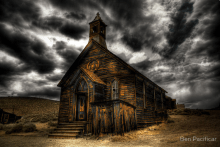
Bodie, California is a ghost town. Or rather, it was a ghost town—now it is a historic park and tourist destination. It endures in a state of “arrested decay,” meaning that nothing can be newly constructed onsite, but neither are its standing buildings permitted to deteriorate any further. The state of California has suspended the town in its process of ruination, stabilizing its entropy and halting its decline. If its decay is forestalled, its grounds rigorously maintained and its aesthetic carefully cultivated, can it be called a ghost town any longer?

Ruin Memories Portfolio online

Numerous studies have focused on modernity’s destructive effect on traditional life- worlds, the desertion of villages and the ruination of rural areas. However, the fact that the modern condition also produces its own ruined materialities, its own marginalized pasts, is less spoken about. Since the 19th century, mass-production, consumerism and thus cycles of material replacement […]
Read More »

Twenty-first century nuisance law and the continued entanglement of race, gender, property, and violence

“It has generally been held that an in most instances rightly held that the degree of dilution necessary is merely that which will prevent a nuisance, having reference primarily to unsightly floating matter and bad odors. For most rivers and many of the smaller streams of the country, this requirement as to the cleanness of […]
Read More »

A review of The Perfect Food and the Filth Disease: Milk, Typhoid Fever, and the Science of State Medicine in Victorian Britain, 1850-1900

Discard Studies has created a new resource page for dissertations and thesis related to the field. The partial review below is taken from Dissertation Reviews, a relatively new online publishing venue for freshly minted research (we highly recommend new graduates submit their work). If you would like your or your advisee’s dissertation on the Discard […]
Read More »

The Atemporality of “Ruin Porn”: The Carcass & the Ghost by Sarah Wanenchak

*This post originally appeared on Cyborgology. Objects have lives. They are witness to things. –This American Life, “The House on Loon Lake” Atlantic Cities’ feature on the psychology of “ruin porn” is worth a look–in part because it’s interesting in itself, in part because it features some wonderful images, and in part because it has […]
Read More »

Detritus from Historic Deadhorse Bay: Trash Meant to be Left Behind

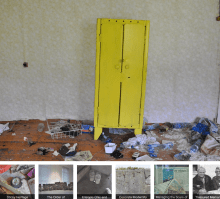
By Max Liboiron A long, long time ago, a younger, grubbier New York City dumped its trash on Barren Island off the south shores of Brooklyn. Barren Island was its own self-contained community and had a one-room school house, four saloons, and five factories boiling garbage all day, everyday. The buildings and island inhabitants–mostly immigrant […]
Read More »

Methodologies: How to Read a Landscape

Discard studies are often entwined with landscapes. Ruins, environmental contamination, xenogarbology (the study of trash in space), ocean plastics, global e-waste flows, and urban waste are all place or space contingent. Thus, reading landscapes can be a valuable methodology for us. A fantastic example is the landscape ethnography Beyond Passaic: Contamination, security threats, hobo encampments. A […]
Read More »