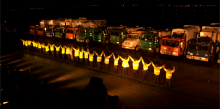
Trash Dance
By Max Liboiron. “When I got to get the stuff in the bucket, first I go down the far left edge of the pile, dump it in. Then I go down the far right side of the pile, dump it in. Then I go down the middle. So everything fits in the back of the […]
Read More »

Gallery of Lost Art: A Treasure Trove of Discard Techniques
The Gallery of Lost Art is an online exhibition via the Tate Modern that explores the materiality, nature, biography and archive of missing works of art.The website explains: Destroyed, stolen, rejected, erased, ephemeral. Some of the most significant artworks of the last 100 years have been lost, and can no longer be seen. Some artworks […]
Read More »

The Politics of Measurement: Per Capita Waste and Previous Sewage Contamination
By Max Liboiron. Measurements are never mere faithful representations of nature, but have social and political origins and ramifications. In representational theory, measurement is “the correlation of numbers with entities that are not numbers,” a process of transformation, translation, and even interpretation at the level of sampling and gathering data. What is selected for measurement and what is […]
Read More »

Race, Class, and Disaster Gentrification
By Zoltán Glück Originally published in Tidal on March 13, 2013 In the days and weeks following Hurricane Sandy the inequalities at the heart of New York City could scarcely be missed. While hundreds of thousands of public housing residents went without heat, hot water or electricity, Mayor Michael Bloomberg rushed to get the stock […]
Read More »

How to picture two tons of waste? Trashy theaters of proof.
Basurama (trash-o-rama), a non profit organization based in Spain, is preparing a public waste audit for MIT’s Media Lab Festival on April 20th. Their unique point of intervention that goes above and beyond a regular waste audit and the goal of quantification and classification of waste, is how to represent two tons of waste. Basurama […]
Read More »
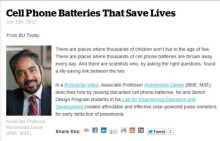
Connecting knowledge about discards to life-saving solutions
In this short video found on the Boston University website, Professor Zaman explains how he and his students use discards to save lives. He is driven by a desire to connect knowledge to real-world solutions for those in developing countries. As part of a classroom project, engineering students at BU sought to improve conditions for […]
Read More »

New York City settles with Occupy Wall Street for unconstitutional trashing
By Max Liboiron. Nearly a year ago, I posted about a lawsuit brought against the City of New York by the People’s Library of Occupy Wall Street for trashing thousands of books during the eviction of Zuccoti Park. The story resonated with a lot of people because the destruction of books is seen as a special type of waste […]
Read More »

Tsunami Debris and the Hope of Return
Guest post by Kim DeWolff via her blog Plasticized. On a sunny spring morning we walk the Arahama coast near Sendai, the largest city in the Tohoku region that experienced the March 2011 tsunami. Two years and a few days later, yellowed grass stands in cracked concrete outlines of houses, bathroom tiles still recognizable. A […]
Read More »

Critical Development in the History of Hoarding
By Zoltana Domotor, from If I was a Hoarder: On December 1, 2012 the board of trustees of the American Psychiatric Association approved the final diagnostic criteria for the fifth edition of the Diagnostic and Statistical Manual, due to be published in May 2013. Among the diagnoses new to the fifth edition of the manual […]
Read More »
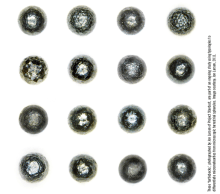
Everyday xenogarbology: Space Dust
By Max Liboiron. One of the central tensions in discard studies is the othering and externalizing of waste that originates in often intimate and everyday spaces and processes. This tension is maintained via material infrastructure (see, for example, Jennifer Clapp’s “The Distancing of Waste” or Coverly’s “Hidden Mountain“) and social), taboo (see Douglas’ Purity and Danger, or Inglis’ […]
Read More »

 Discard Studies