Category Archives: Architecture

Keyword: Deconstruction Waste (Building)

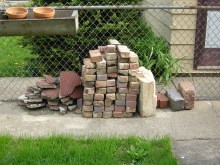
By Susan Ross Building deconstruction refers to the careful taking apart of a building to salvage its reusable materials and components. These are either stored on site for short-term integration in a new design, or removed to a salvage yard for use at a later date. Whereas prevailing mechanical demolition creates mounds of unsorted debris […]
Read More »
Reconciliation’s Waste: heritage and waste in post-apartheid South Africa

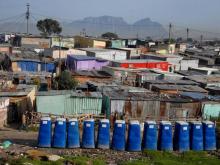
Portable toilets and urine on colonial era statues are reconciliations ruins, the things leftover that heritage helps to frame but yet cannot fully explain. As matter that remains unresolved, I think it tells us about the unfinished work of reconciliation in South Africa.

Designing for the Future at Giant Mine

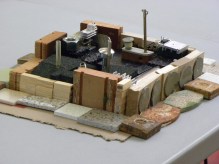
How do you communicate permanent pollution and toxicity to future generations? We held workshops with community members in Yellowknife and Dettah to make models about they would communicate the dangers of buried arsenic at the local Giant Mine into the future.

Wasted Heat as Northern Commons: Hot Spots in the Square

Our project aims to unveil the potential for the Commons within the outdoor urban infrastructure of Churchill Square in St. John’s, Newfoundland, by locating heat leaks from wasted heat. We wanted to find out which areas in the Square provided a bit of warmth during the long, cold winter to imagine the possibility of public congregation or reclaimed community space.

The Perils of Ruin Porn: Slow Violence and the Ethics of Representation

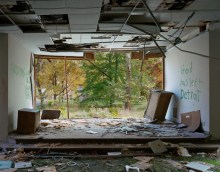
The main argument against cinematic, photogenic images of ruination is that they can work against revitalization, and obscure systemic problems that cause certain patterns of ruination and harm.

Arrested Decay: The Exorcism of an American Ghost Town

Bodie, California is a ghost town. Or rather, it was a ghost town—now it is a historic park and tourist destination. It endures in a state of “arrested decay,” meaning that nothing can be newly constructed onsite, but neither are its standing buildings permitted to deteriorate any further. The state of California has suspended the town in its process of ruination, stabilizing its entropy and halting its decline. If its decay is forestalled, its grounds rigorously maintained and its aesthetic carefully cultivated, can it be called a ghost town any longer?

Review: The City Recycled: The Afterlives of Demolished Buildings in Post-war Beijing

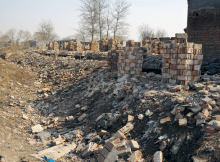
Shih-yang Kao’s dissertation on demolition waste in Beijing provides rich material for scholars interested in the players involved in urban-rural discard commodity chains. While post-demolition waste was considered a resource for both socialist (1949-1978) and reform era (1978-present) governments, The City Recycled: The Afterlives of Demolished Buildings in Post-war Beijing narrates how values of waste shifted for each period, as well as how it continues to shift under different present-day policies, geographical locations, regional and local economies, and stakeholder groups.

Ruin Memories Portfolio online

Numerous studies have focused on modernity’s destructive effect on traditional life- worlds, the desertion of villages and the ruination of rural areas. However, the fact that the modern condition also produces its own ruined materialities, its own marginalized pasts, is less spoken about. Since the 19th century, mass-production, consumerism and thus cycles of material replacement […]
Read More »

The Atemporality of “Ruin Porn”: The Carcass & the Ghost by Sarah Wanenchak

*This post originally appeared on Cyborgology. Objects have lives. They are witness to things. –This American Life, “The House on Loon Lake” Atlantic Cities’ feature on the psychology of “ruin porn” is worth a look–in part because it’s interesting in itself, in part because it features some wonderful images, and in part because it has […]
Read More »

Wall Dogs

Writing for Biz Journals, Michael DeMasi reports on Albany, New York’s efforts to preserve fading advertisements on the sides of city buildings. As part of Albany’s Sculpture in the Streets exhibit (sponsored by the Downtown Albany Business Improvement District), the work of 19th and early 20th century “wall dogs” (muralists who adorned buildings with colorful […]
Read More »