Category Archives: Waste

Review: The City Recycled: The Afterlives of Demolished Buildings in Post-war Beijing

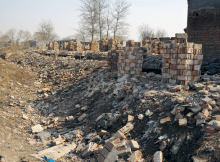
Shih-yang Kao’s dissertation on demolition waste in Beijing provides rich material for scholars interested in the players involved in urban-rural discard commodity chains. While post-demolition waste was considered a resource for both socialist (1949-1978) and reform era (1978-present) governments, The City Recycled: The Afterlives of Demolished Buildings in Post-war Beijing narrates how values of waste shifted for each period, as well as how it continues to shift under different present-day policies, geographical locations, regional and local economies, and stakeholder groups.
The Decompository at the Arnold Arboretum

Most Arboretums don’t put their dirt, waste, and decomposition on visitor maps. In July, via a workshop on Digital STS at Boston’s Arnold Arboretum, we fixed that. We created “The Decompository” for the Arboretum. The Decompository cataloged the entire, often dirty, frequently smelly, certainly decomposing urban ecology of the park could be made more apparent for visitors and researchers.

Body Burdens, Biomonitoring, and Biocitizenship

By Max Liboiron, Lindsey Dillon, and submitting authors. Since at least the publication of Silent Spring, scientists, policy-makers, and the general public has focused on pollution in the environment as the object of regulation and control, a source of fear and anxiety, and the subject of scientific testing. As technologies, analytical detection limits, and eco-populist, […]
Read More »

Chennai Waste, Part 3: Perungudi: A fortress of trash

For Sendhil, it’s all about keeping the trucks coming in at the right time, at the right pace. “If work stops here, then they’ll be a line of trucks waiting, people’s trash won’t get picked up. So, we just have to make sure everything keeps going.” Thus, he’s not concerned about segregation, or recycling. What he needs are good roads, infrastructure, he says. Only with that can they keep pushing the trash away from the houses, and prevent “incidents” like the small fires that break out on occasion.

Ruin Memories Portfolio online

Numerous studies have focused on modernity’s destructive effect on traditional life- worlds, the desertion of villages and the ruination of rural areas. However, the fact that the modern condition also produces its own ruined materialities, its own marginalized pasts, is less spoken about. Since the 19th century, mass-production, consumerism and thus cycles of material replacement […]
Read More »

The Plastisphere and other 21st century waste ecosystems

By Max Liboiron. You’ve probably heard of “The Great Pacific Garbage Patch” or “The Gyre,” or other names given to the phenomenon of ocean plastics. You may have asked yourself why we just don’t clean it all up with a giant sea-vacuum. You may have even seen inventions meant to do just that. But perhaps […]
Read More »

Paradoxurus, or the best cup of joe

I have nothing to add to this one. Published in the pages of Foodservice Director Magazine (July 15, 2013).

E-waste Academy for Scientists and Social Scientists (deadline July 31)

Organised by the United Nations University under the aegis of the StEP Initiative, the EWAS has over the past three editions brought together nearly 60 young researchers from around the world, looking at solving the e-waste from different disciplinary perspectives. It has become the foremost forum available to young scientists to share their knowledge, interact […]
Read More »

Detritus from Historic Deadhorse Bay: Trash Meant to be Left Behind

By Max Liboiron A long, long time ago, a younger, grubbier New York City dumped its trash on Barren Island off the south shores of Brooklyn. Barren Island was its own self-contained community and had a one-room school house, four saloons, and five factories boiling garbage all day, everyday. The buildings and island inhabitants–mostly immigrant […]
Read More »

Methodologies: How to Read a Landscape

Discard studies are often entwined with landscapes. Ruins, environmental contamination, xenogarbology (the study of trash in space), ocean plastics, global e-waste flows, and urban waste are all place or space contingent. Thus, reading landscapes can be a valuable methodology for us. A fantastic example is the landscape ethnography Beyond Passaic: Contamination, security threats, hobo encampments. A […]
Read More »